
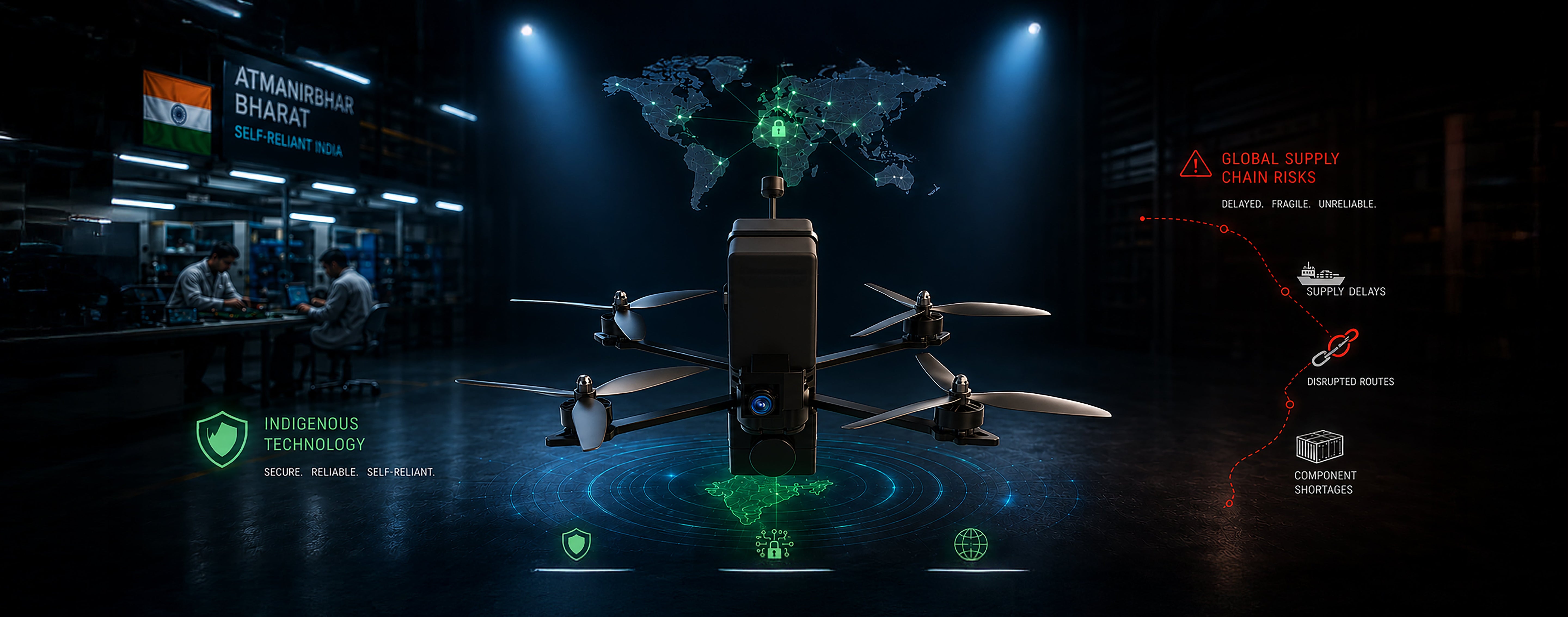
The rapid growth of drone technology has transformed industries ranging from defence and surveillance to agriculture, infrastructure inspection, and disaster management. As drones become increasingly integrated into critical operations, one challenge has emerged as a major concern for governments and industry alike: supply-chain security.
Why Is Supply-Chain Security Becoming a Critical Concern for the Drone Industry?
A drone is far more than an airframe with propellers. Modern unmanned aerial systems (UAS) rely on a complex network of electronic components, including flight controllers, communication modules, navigation systems, power distribution boards, sensors, processors, and firmware. The security, reliability, and availability of these components directly determine the effectiveness of the entire platform.
What Risks Arise from Dependence on Foreign-Sourced Drone Components?
Recent geopolitical developments and evolving cybersecurity threats have highlighted the risks associated with excessive dependence on foreign-sourced drone components. Vulnerabilities hidden within imported hardware or software can expose critical systems to cyberattacks, unauthorized access, data theft, communication interception, and even operational disruption. As a result, governments worldwide are placing greater emphasis on trusted and secure supply chains.
How Is India Addressing Drone Supply-Chain Security?
India’s Ministry of Defence has recently reinforced this approach through its drone security framework, which mandates rigorous testing of hardware and software vulnerabilities in drones procured by the armed forces. The framework recognizes that supply-chain security is now a critical element of national security. It encourages the development of trusted domestic ecosystems capable of delivering secure and reliable drone technologies.
Why Are Indigenous Components Essential for Secure Drone Ecosystems?
Indigenous components play a crucial role in achieving this objective. By designing and manufacturing critical drone electronics within the country, organizations gain greater visibility into the entire product lifecycle. Local development enables better control over sourcing, production processes, quality assurance, firmware management, and security validation. This transparency significantly reduces the risk of hidden vulnerabilities entering the system through opaque global supply chains.
How Do Indigenous Components Improve Supply Continuity?
Another major advantage of indigenous components is supply continuity. Global disruptions, trade restrictions, geopolitical tensions, and export controls can severely impact access to critical technologies. Organizations that depend heavily on foreign suppliers may face delays, cost increases, or sudden shortages. Indigenous manufacturing helps mitigate these risks by creating resilient domestic supply networks capable of supporting long-term operational requirements.
Can Local Manufacturing Strengthen Technical Support and Maintenance?
The use of locally developed drone electronics also strengthens technical support and maintenance capabilities. Engineers can work closely with manufacturers to customize solutions, address security concerns, and implement updates more efficiently. This level of collaboration is often difficult to achieve when relying on overseas suppliers operating across different regulatory and geopolitical environments.
How Is India's Drone Industry Supporting Indigenous Development?
India’s emerging drone ecosystem is already witnessing the rise of companies focused on indigenous UAV technologies. Firms such as Skybit™ are developing mission-critical drone components including flight controllers, power distribution systems, and carrier boards designed for modern unmanned platforms. Such efforts contribute to building a trusted domestic technology base while supporting the broader goals of Atmanirbhar Bharat and Make in India.
Does Indigenous Manufacturing Drive Innovation Beyond Self-Reliance?
Importantly, indigenous manufacturing does not simply reduce external dependency; it also accelerates innovation. Local companies gain the opportunity to develop solutions tailored to India’s unique operational requirements, environmental conditions, and defence priorities. This creates a virtuous cycle of innovation, testing, deployment, and continuous improvement.
Why Should Component Traceability Matter as Much as Drone Performance?
As drones become increasingly important across both civilian and military applications, supply-chain security will remain a defining factor in technology adoption. Organizations can no longer evaluate drone systems solely on performance metrics such as endurance, payload capacity, or range. The origin, security, and traceability of the underlying components have become equally important.
What Does the Future Hold for India's Drone Supply Chain?
The future of India’s drone industry will depend not only on building advanced platforms but also on establishing secure, transparent, and resilient supply chains. Indigenous components represent a critical step toward that goal, helping reduce supply-chain risk while strengthening technological sovereignty, national security, and long-term industry growth.
How Indigenous Component Manufacturers Like Skybit™ Support Supply-Chain Security
As India strengthens its focus on secure and self-reliant drone ecosystems, indigenous component manufacturers play an increasingly important role in reducing supply-chain risks. Companies developing critical UAV electronics within the country contribute to greater transparency, traceability, and control throughout the product lifecycle.
Skybit™ is part of this growing ecosystem, focusing on the development of mission-critical drone components such as flight controllers, power distribution boards, and carrier boards for modern UAV platforms. By designing and manufacturing these core systems domestically, Skybit™ helps address several challenges associated with foreign dependency, including supply uncertainty, limited visibility into component origins, and extended support cycles.
Local development also enables closer collaboration between drone manufacturers, system integrators, and component engineers, helping accelerate customization, validation, maintenance, and firmware updates. This approach aligns with the broader objectives of building trusted supply chains, strengthening indigenous technological capabilities, and supporting India's vision of Atmanirbhar Bharat.
As demand for secure and reliable drone technologies continues to grow across defence and civilian sectors, organizations developing indigenous UAV electronics will play a vital role in creating a resilient, future-ready drone ecosystem for the nation.
Conclusion
As drones continue to evolve from tactical tools into critical assets for defence, surveillance, infrastructure monitoring, and industrial operations, supply-chain security has become a strategic priority rather than a procurement consideration. The integrity of a drone depends not only on its airframe and performance capabilities but also on the security, reliability, and traceability of the components that power it.
India's growing focus on trusted supply chains and indigenous technology development reflects a broader recognition that technological sovereignty and operational security are closely interconnected. By investing in locally designed and manufactured drone electronics, organizations can reduce dependency on external sources, strengthen resilience against supply disruptions, improve security oversight, and foster innovation tailored to national requirements.
As the drone ecosystem continues to expand, the question will no longer be whether indigenous components are important, but how quickly the industry can scale secure and trusted domestic capabilities. Building advanced drones is essential, but building them on a foundation of secure, transparent, and indigenous technologies will be the key to achieving long-term growth, operational reliability, and strategic self-reliance.